Revamp of Filecoin's Build Website for Improved Usability
Filecoin.io

View Case Study

YEAR
ROLE
Company
In our winning hackathon project for General Assembly's UX Design Intensive course, my team developed a mobile app to address the following prompt:
How might we strengthen school communities, and improve outcomes for students and teachers, as we experience the unpredictable ups-and-downs of the COVID Pandemic, by highlighting solutions that reconnect people and enhance collective wellbeing, teaching, and learning?
Julia Armbrust // Jordana Esh // Aaron Riggs
6 hour design sprint
Figma, Miro, Google Workspace, Slack, Zoom
Secondary Research, Wireframing, Prototyping
Students and teachers returning to school need a routine way to access mental health resources because of a current lack of understanding around mental health offerings, inadequate structures for accessing services, and inequitable resources currently available.
ZenGrowth is a mobile therapy and scheduling app that places an equal emphasis on mental health and school. Through ZenGrowth, students can seamlessly integrate therapy and other mental health offerings into their daily lives.
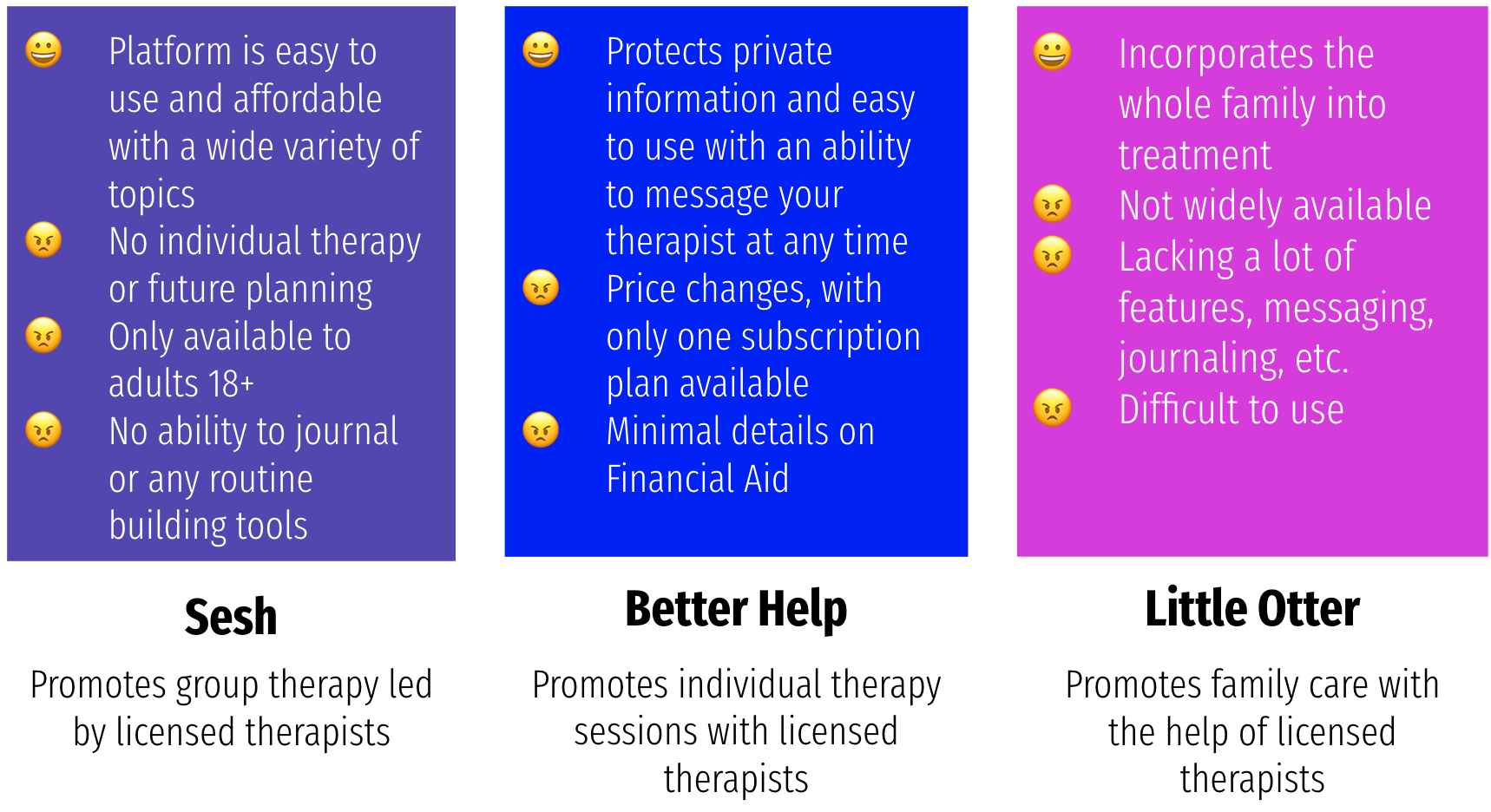
After deciding to focus on mental health offerings for students, we performed a competitive analysis comparing three different mental health apps: Sesh, Better Help, and Little Otter. While some elements like ease of use and privacy helped inform our design, other features were lacking. This left room for our designs to incorporate features that would stand apart from the crowd and better serve potential users.
Through research, we discovered a mental health crisis prevalent among US teens:
• Emergency department visits for suspected suicide attempts among adolescents jumped 31% in 2020
• 1 in 4 US adolescents experience depression in 2020
• 1 in 5 US adolescents experience anxiety
Providing opportunities for mental health support in school seems like our best option. “Not only do more youth initiate services when they’re offered in schools, they are much more likely to complete treatment when they’re offered in schools than when offered in other community settings.” (Sharon Hoover, co-director of the National Center for School Mental Health at the University of Maryland School of Medicine). Furthermore, "although ASCA recommends a 250-to-1 ratio of students to school counselors, the national average is actually 427-to-1 for the 2020–2021 school year..." (ASCA).
So, while schools are the best place to support the increasingly severe mental health crisis, they need help in doing so.
The Hybrid Learning Student
The high school hybrid learning student experiences tremendous pressure from ongoing school and extracurricular activities. They feel uncomfortable talking to their parents because of a generational and cultural stigma around talking about mental health. The student is struggling to keep up with their school work and is looking for extra help to manage stress.
In order to achieve our aim of incorporating mental health services into students' daily schedules, our team decided to prioritize group sessions, video communication, and messaging therapy.
The group sessions stemmed from research that community-oriented sessions are greatly beneficial to those struggling with mental health as well as from an understanding that schools are already stretching their resources.
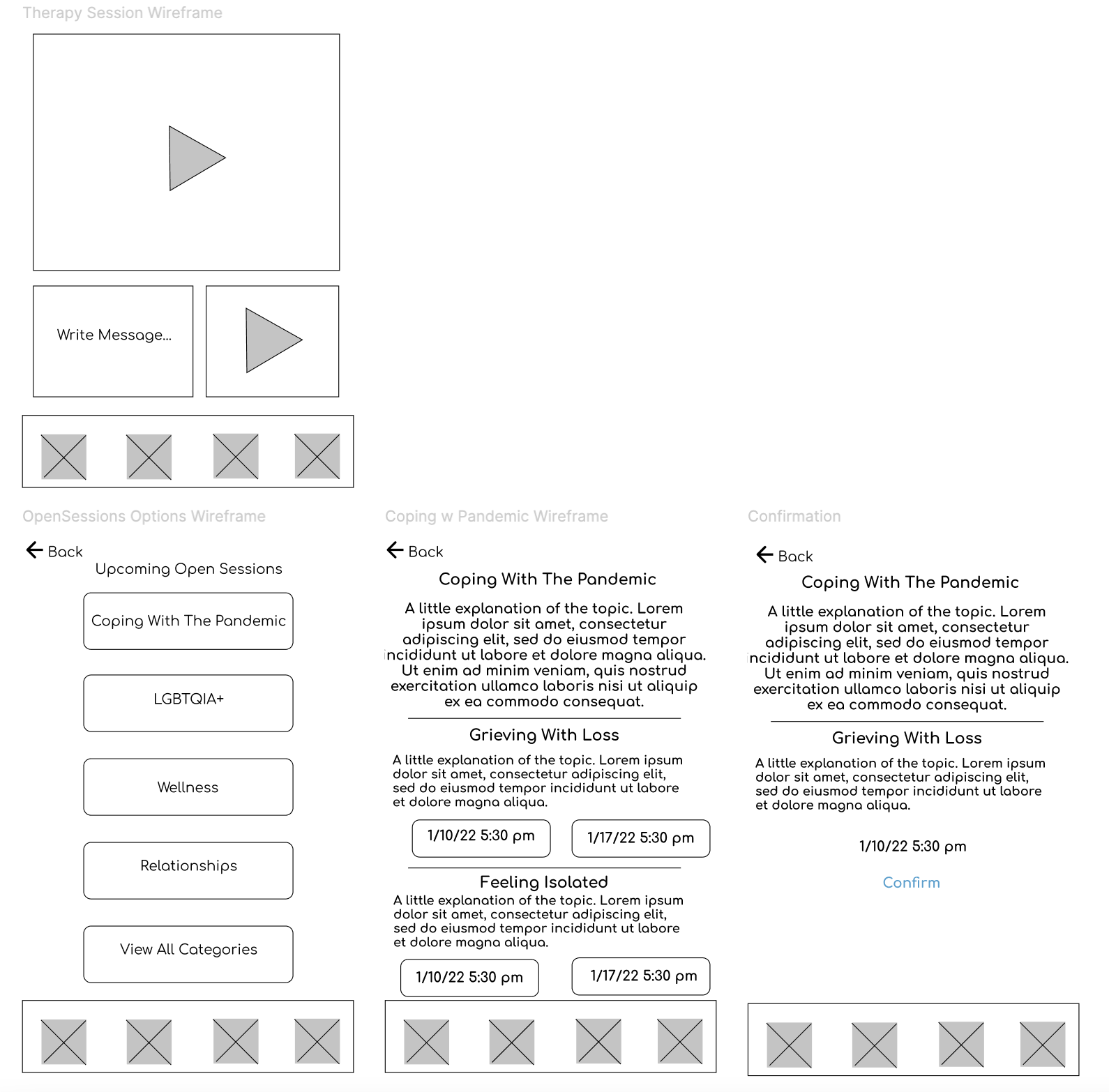
My primary role was to design our mid-fidelity prototype in its entirety. Setting aside time for research, testing, and presentation prep, I spent about three total hours on the Figma Prototype.
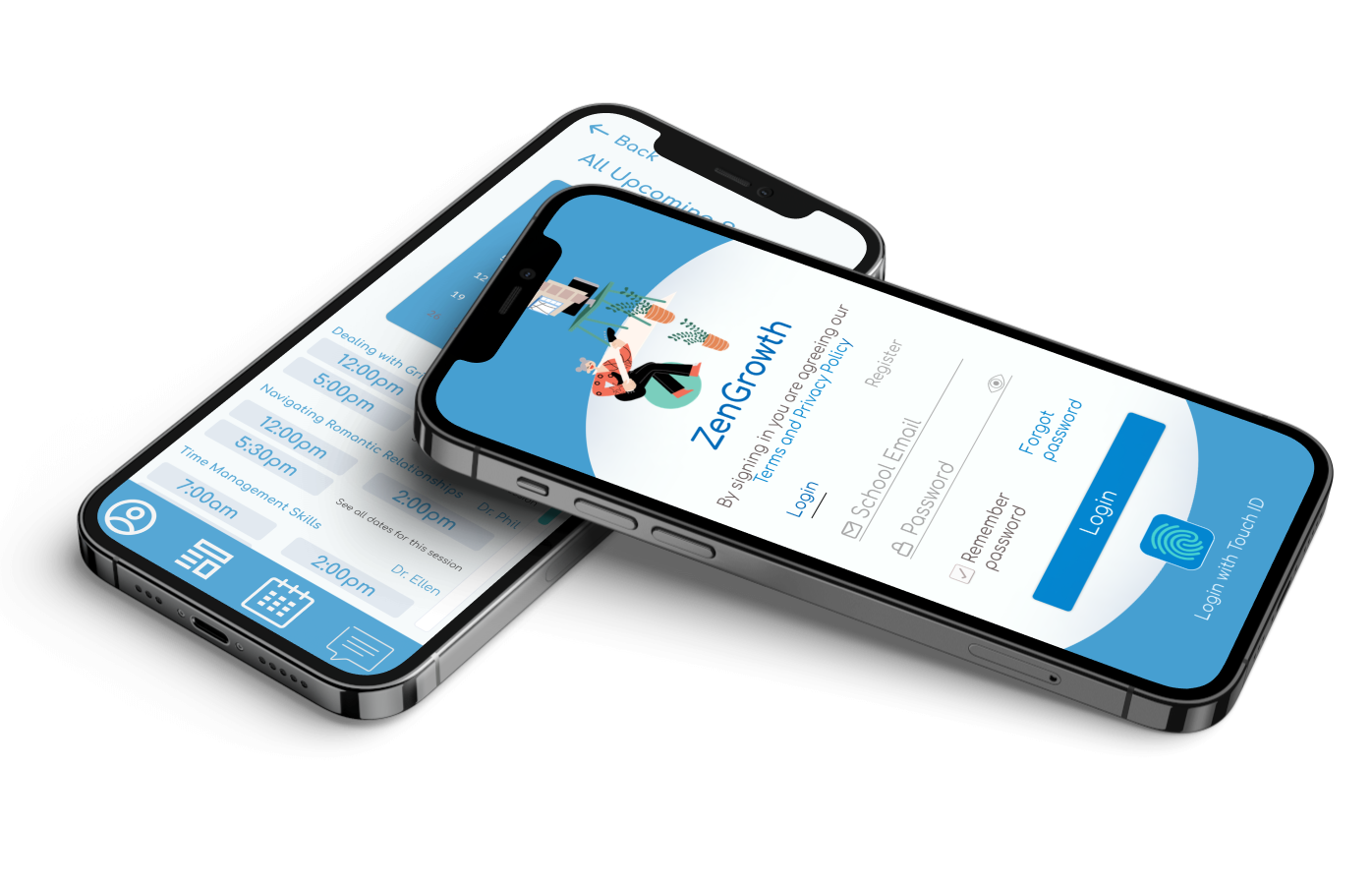
We wanted to emphasize the importance of incorporating therapy into the daily lives of students. Anyone logging in would have their school information and other demographics pre-loaded (assuming integration with school platforms) or uploaded (assuming no integration). Students would also have the option to upload their schedules as a way to manage daily requirements.
In the User Profile, students would also enter goals, which could range from academic achievements to achievements in addressing mental health, like completing 10 therapy sessions or participating in community-oriented sessions.
Based on pre-entered goals, students can track their progress and be encouraged by their own growth and mental health acumen. The user journal also offers daily checkpoints; these checkpoints also allow users to look back, identify trends, and see how they've progressed over the course of the school year.
The ability to access different models of mental health resources (though through the same medium, ZenGrowth) was crucial given the constantly changing modes of education during the pandemic. So, you'll see messaging therapy, live video conferencing, and group therapy sessions accessible all within the same app. This would also encourage reluctant students to explore and join therapy options that fit their comfort level.

Try our prototype out for yourself (pro-tip: try a virtual therapy session or scheduling an open session), below orhere.
With an increased focus on mental health offerings for students, there's a huge opportunity for innovation. Developing a program that's easy to implement and assists schools stretched thin by the pandemic will allow for more equitable access to the students most at risk.
Research and Ideation
• Conduct user interviews and user tests and get more data to inform design iterations
Partnerships & Growth
• Continue to build a team of designers, engineers, & licensed therapists to help more people.
• Partner with school districts to implement ZenGrowth into their curriculum
• Partner with state governments to help get funding and roll-out school programs
• Partner with large companies & teams to help unity and awareness to employees wellbeing
• Continue to destigmatize mental health issues & improve education and awareness around resources