Revamp of Filecoin's Build Website for Improved Usability
Filecoin.io

View Case Study

YEAR
ROLE
Company
Tasked by General Assembly with designing a solution to empower marginalized creatives facing barriers in their industry, I decided to learn more about the visual art marketplace. Aided by my own assumptions, instincts, and experience in scouring the web for original artwork, I set out to design a mobile solution: Collectr.
11 Days
Balsamiq
Interviews, research, user flows and wire framing, sketching, prototyping
Art seekers need a better way to discover original artwork due to the barriers that impede artists, particularly those who identify with groups who have been historically marginalized in the art marketplace, from promoting and selling their own work.
After extensive research, I designed a mobile marketplace, Collectr, whose mission is to connect visual artists — particularly marginalized folx — with casual art buyers through the use of the instinctual swipe.
With just two weeks to craft a solution to a problem that has existed for centuries, I struggled with coming up with a one-size-fits-all approach to the problem. Instead I focused on a subset of people who regularly buy art for personal consumption.
Without buyers, the visual art marketplace would simply not exist. With Collectr, artists would have direct access to future buyers, and buyers would have a streamlined way to find and procure original pieces. While my focus shifted to the buyer’s experience, I wanted to make sure the idea did not lose focus from the original goal — to support marginalized artists and allow their work to thrive in the artistic landscape.
I worried that asking pointed questions in my interviews about marginalized artists would influence the responses to my questions and falsely skew data. Instead I focused on questions that spoke to real life experiences about art that existed in my interviewees homes.
Finally, I did not record race and ethnicity demographics of my interviewees. This has very likely limited the scope of my findings.
I conducted informal interviews with 10 potential users to achieve my interview goal of determining what motivates art purchases & what roadblocks exist in buying or selling art.
By The Numbers
• All 10 interviewees were between the ages of 23 and 35
• 7/10 interviewees were women4/10 interviewees were artists
• 3/10 interviewees were classmates in the General Assembly UX Design Immersive bootcamp
• All 10 interviewees have purchased art for personal use
• 8/10 interviewees have purchased art in the last year
Surprise, Surprise...
As I began my interviews, I ran into a problem. “Sure, I care about the artists,” said more than one interviewee, almost convincingly. “But, it’s really more about aesthetic and price.” My entire project so far had been grounded in the assumption that artists sell the art, and here people were telling me that they didn’t know anything about the person behind their purchases.
In fact, while 4/10 people interviewed said they were likely to consider the artist when making an art purchase, “Who is the artist?” did not make anyone’s primary list of considerations when purchasing art.
What did make the list of considerations was sometimes hard to verbalize, namely because every person I interviewed said they knew instantly whether they liked a piece of art or not. Beyond innately knowing whether something spoke to them or not, the primary factors when purchasing art were:
1. “Does the piece match my aesthetic?”
2. “Does the piece fit in my home?”
3. “Is this piece within my budget?”
I organized my findings and direct quotes into an affinity map to identify themes, categorize, and visualize my interview notes.
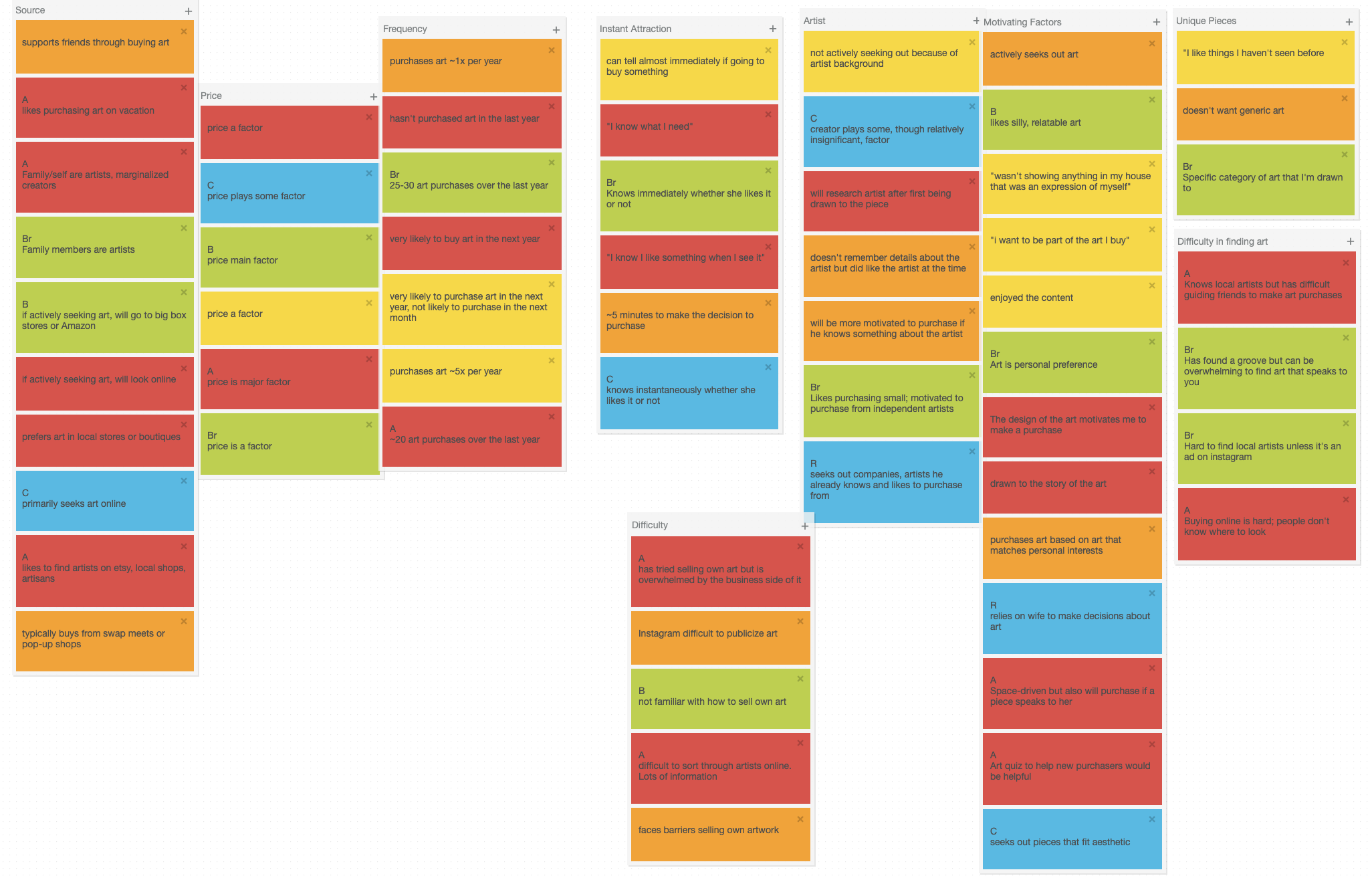
People can instantly tell whether they like art.
In general, who the artist is is not a main consideration for art buyers.
Buying and selling art is overwhelming in the current landscape unless you get lucky.
With a short time frame and the surprise finding from my interviews that people generally don’t care about the artist, secondary research was a crucial next step in understanding the problem so that I could begin to ideate on solutions.
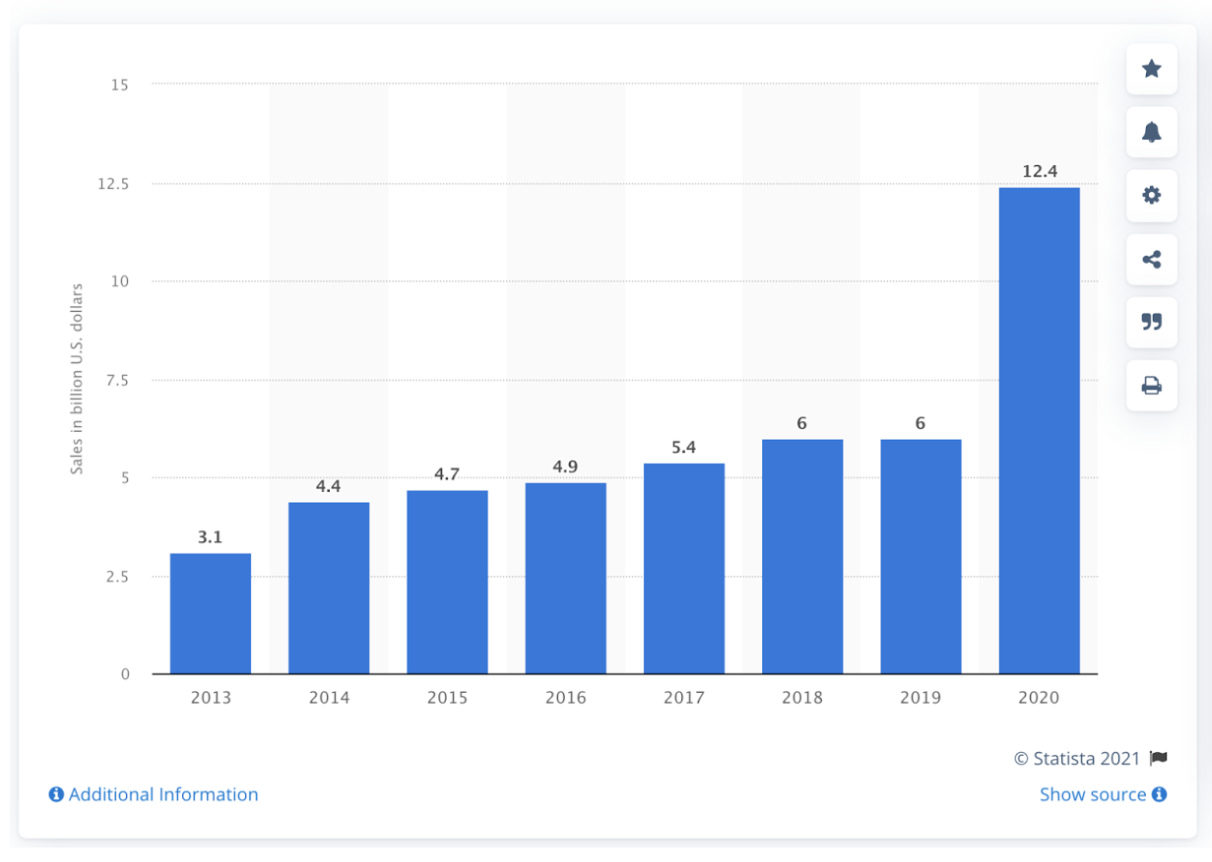
There’s a lot of money to be had in the art world — Statista reports that in 2020, the global art market was a $50 billion industry despite a decline from 2019 likely due to the pandemic. Furthermore, online art sales boomed in 2020, with a notable 200% increase over the year before (also likely catalyzed by the pandemic).
And yet, Zippia reports that an overwhelming 73% of working artists are white. The disparity is potentially enhanced by algorithmic biases towards white creators reported across social platforms like Instagram, which are now being used for artists to promote their work. Additionally, while the split between male working artists and female working artists is more promising, male working artists are making 6% more in annual income. Seeing these stats reinvigorated my focus in creating a space that would increase the likelihood of exposure and promotion for marginalized artists.
So, how do we design a solution? Thankfully I wasn't starting from square one. I wanted to see what's being tested and found examples from Yelp and Google, who have each added tools to their search features to better support Black-owned and Asian-owned businesses. What's more, research is showing that it's working: Black business promoted by Google's new search feature are reporting higher sales and more website hits.
In doing market research, I explored some great art marketplaces like Artfinder, Society6, and Etsy - all of which have improved the way buyers can find art online. However, all slightly miss the mark in addressing how to give marginalized artists a fair shot in the space.

Remembering that people can tell instantly whether they like the looks of something or not, my mind kept returning to another area where instant judgement exists…the dating world.
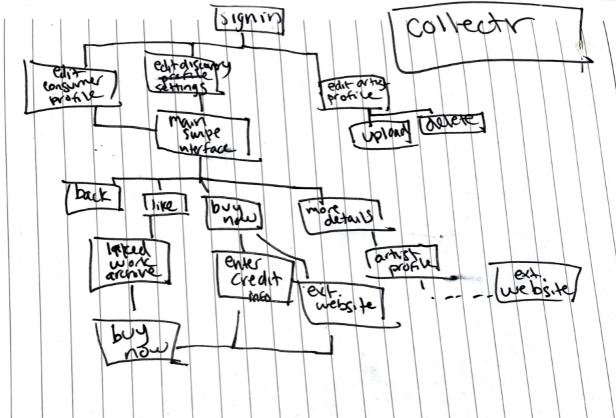
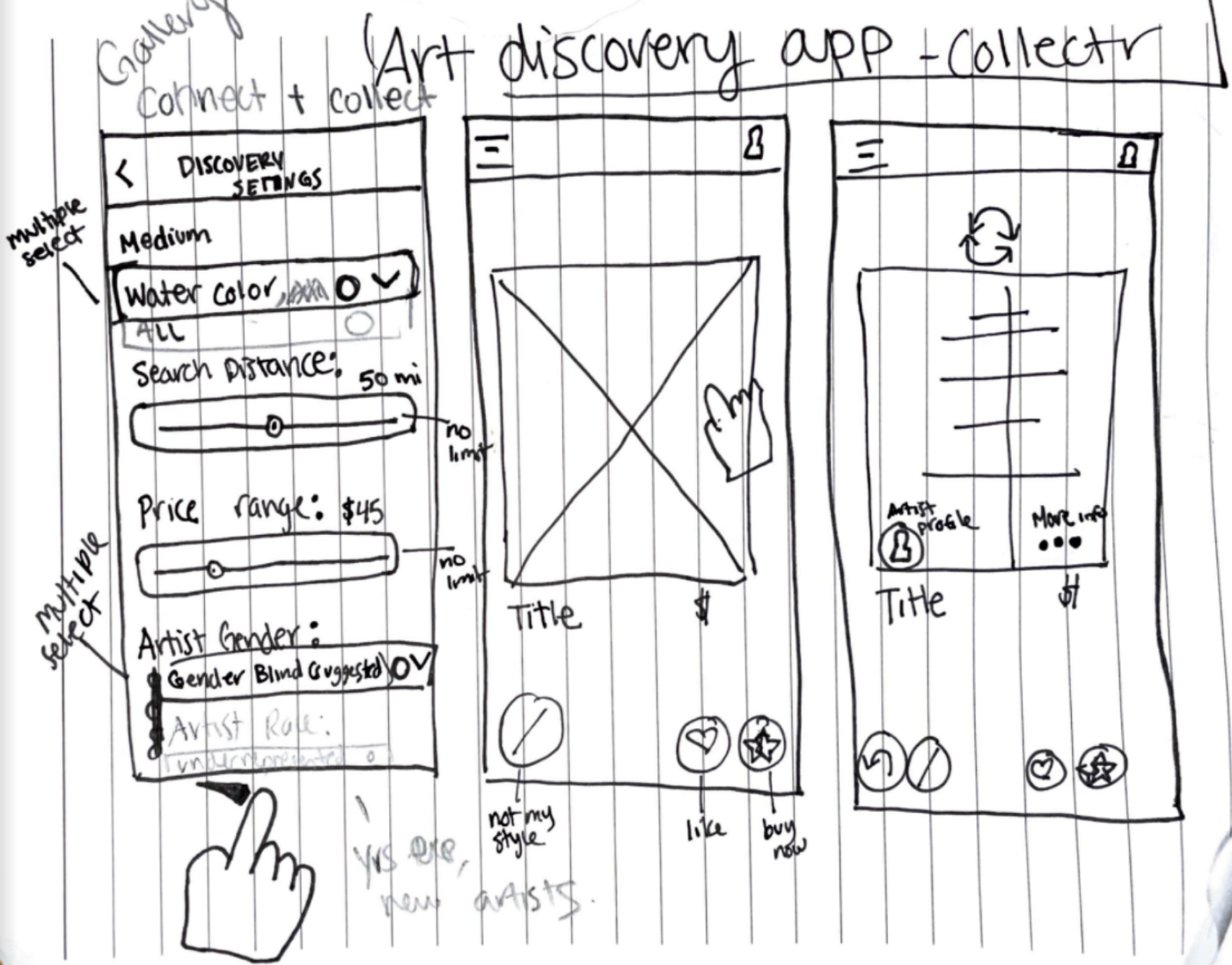
I thought of the intuitive — though oft criticized — action swiping yes or no based on attraction, and so my first sketches drew inspiration from dating apps as well as the short form video app TikTok, where instant reactions help small creator content go viral. The below image is a preliminary user flow, and below is an early sketch of the art cards as well as discovery settings.
As an aside - I've since gotten better sketch paper, and my chicken scratch has gotten much less chicken scratch-y since these early designs... Maybe.
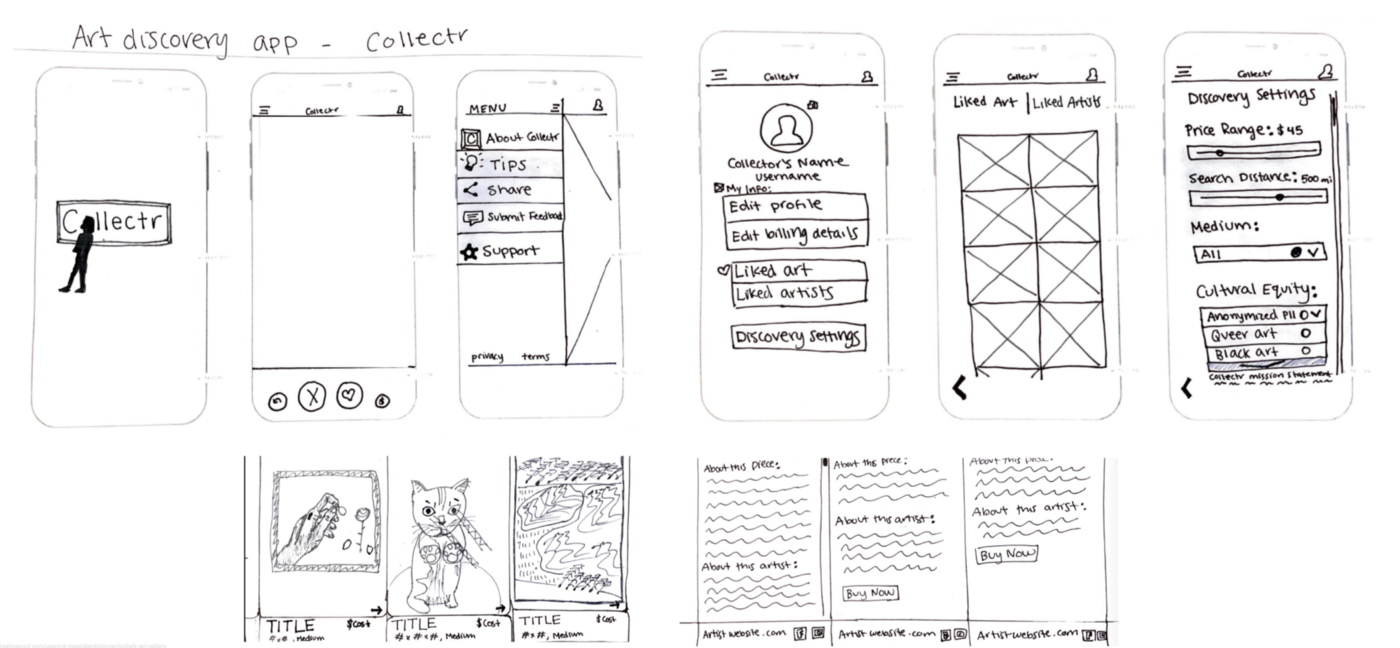
With preliminary feedback from my early sketches, I sketched out a paper prototype. From the left, you are looking at: Splash Screen, Swipe Page, Menu Bar, User Profile, User Gallery, Discovery Settings, and Art Cards in the Collectr Paper Prototype
I conducted seven user tests (three live and four async) asking each participant to complete simple tasks within the app. So far, the app design had been driven through my own assumptions and preference. Through testing, I learned that the app needed to be better organized and needed to place more emphasis on the artists.
Some changes included:
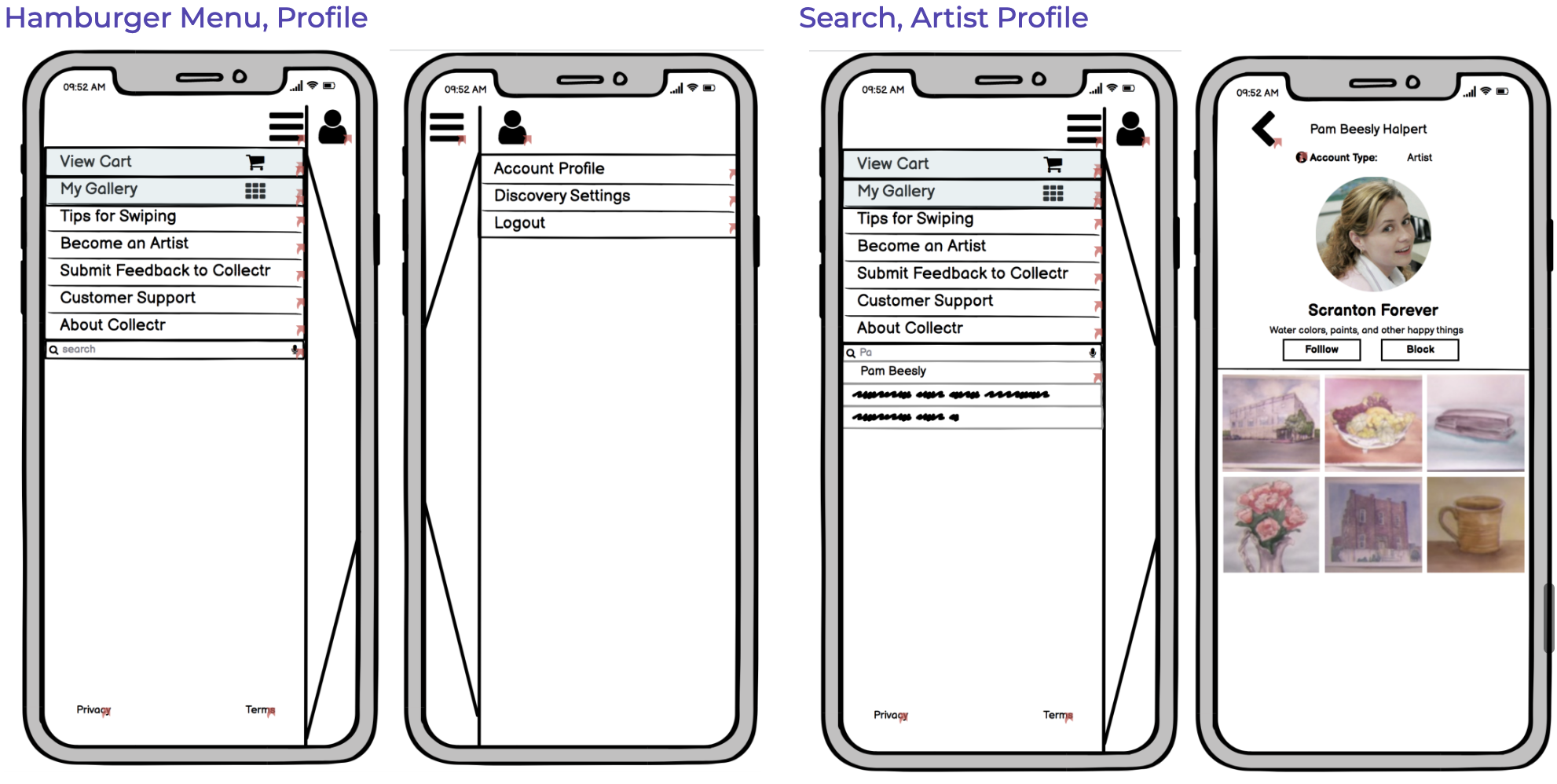
• Feedback 1: The hamburger menu and profile options are not intuitive
• Update 1: I removed gallery view and cart from the profile options to the hamburger menu
• Feedback 2: Registration is confusing and repetitive
• Update 2: I rerouted the Discovery Page to go to the main swipe page upon completion
• Feedback 3: It is unclear how users should be interacting with artists
• Update 3: I added the search feature and artist profile to my prototype
After receiving more feedback, I created and iterated on a low fidelity prototype in Balsamiq.
Designing the swipe feature was relatively straightforward, given the great and intuitive that exist across dating sites like Tinder, Grindr, Bumble, and Hinge.
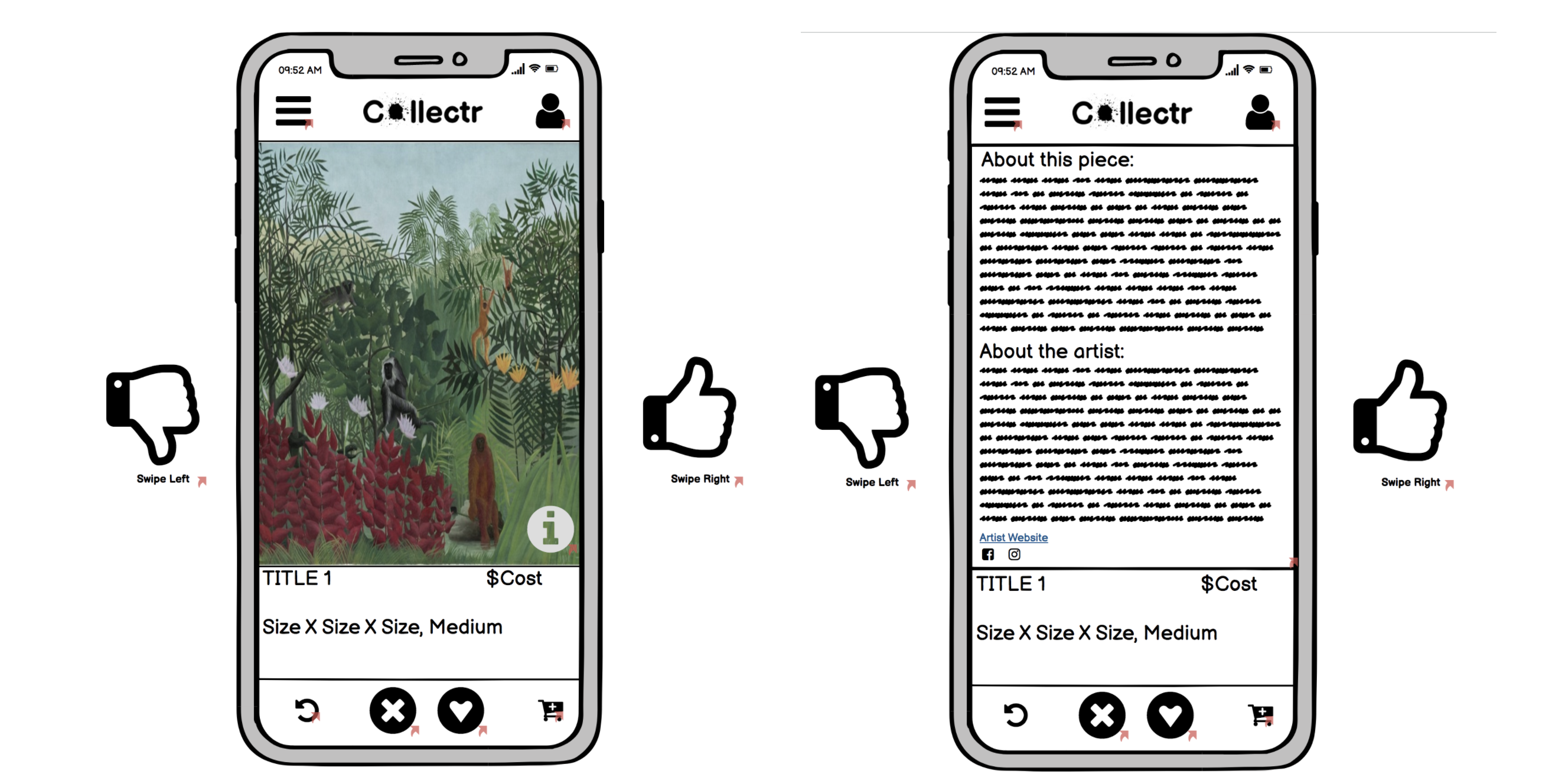

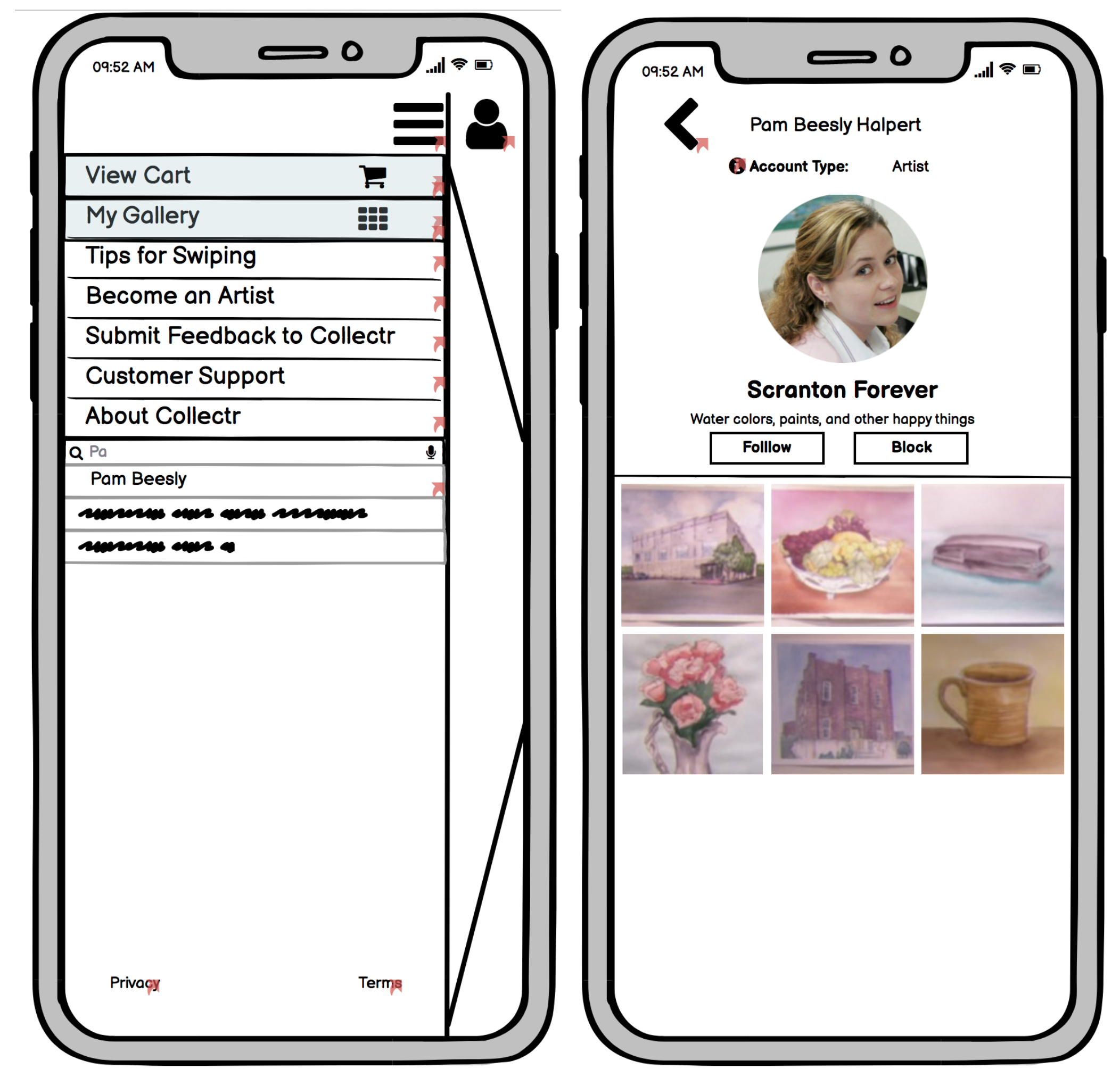
Several other features and processes, like the user gallery, user profile, and checkout took inspiration from Instagram, TikTok, and Etsy. This made it easy for users to navigate during testing.

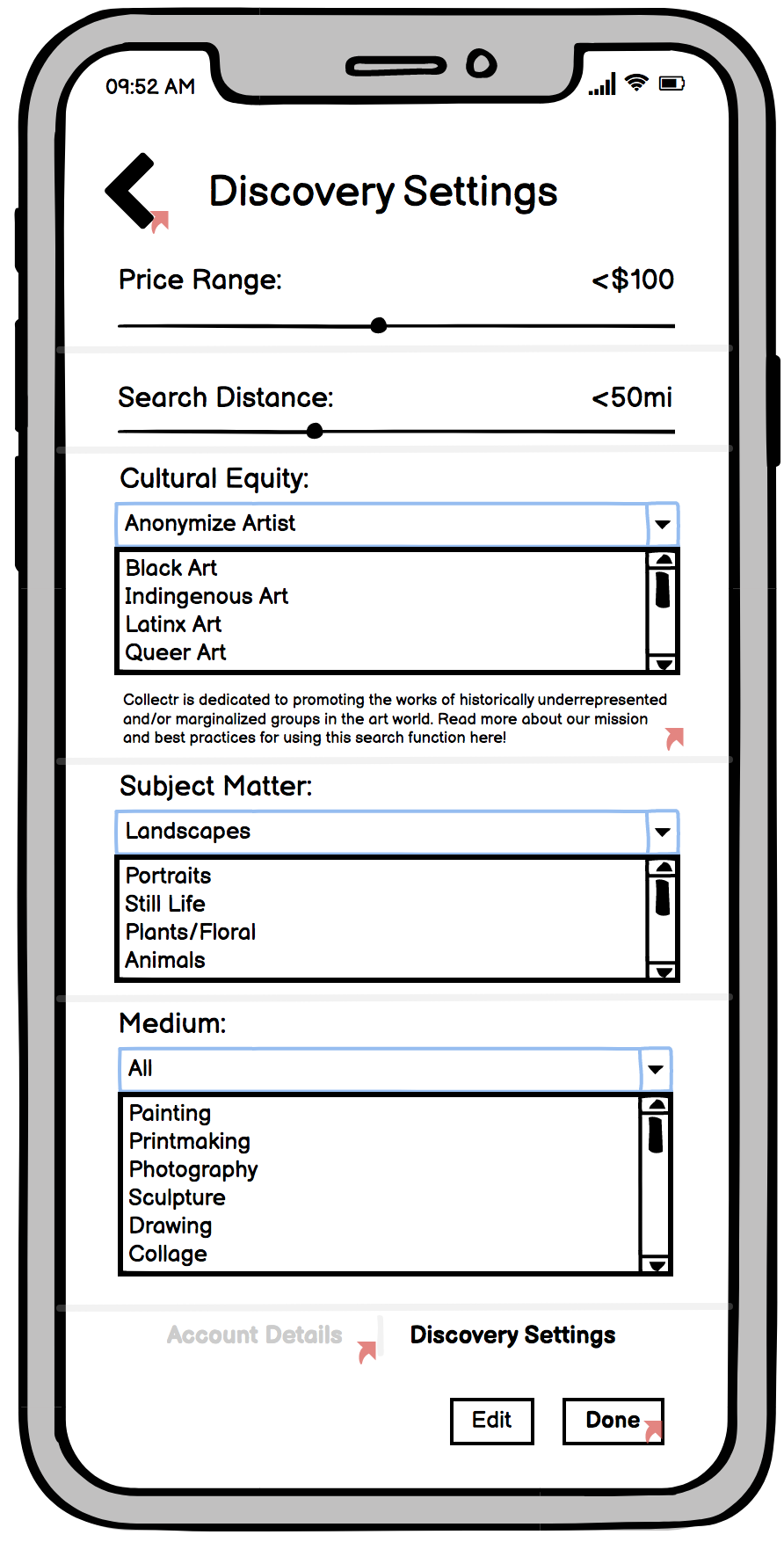
Finally, my focus returned to the discovery settings page, which is the bread and butter of Collectr. From my findings, how are people looking for art? And, from my research, what search tools can provide immediate assistance to marginalized artists?
As I learned, most of people don’t decide on what art to buy based on the artist. But, research has proven that if the search function is available, people may actively seek out ways to support marginalized creators and business owners. Furthermore, in other fields like tech recruiting, anonymizing data has successfully diminished the effects of unconscious biases.
Including cultural equity selections on the discovery page is a straightforward way to promote diversity in the art that buyers see and select. And, since, my interviews showed that people really care about aesthetic, fit, and price when buying art, these search filters are readily available to users and can be updated at any point.
At the end of the two-week design sprint, I landed on a mobile marketplace that would give marginalized artists a fair shot at finding buyers for their work while giving buyers access to original pieces in a way that relies on the buyer’s instincts — within their specified parameters, of course. In its current design, Collectr serves as a matchmaking service between artists and buyers. Supporting marginalized creatives comes down to leveling the playing field and adding search functionality that would allow for more intentional support of marginalized artists.
My work is not done, though.
Throughout the project, my focus shifted to the buyer’s experience as a way to provide immediate support to artists. However, for next steps I’d like to interview more marginalized artists and place more emphasis on the artist’s user flow — like shipping logistics and community building. From several marginalized artists I spoke to, I also heard how important community has been in creating space for their work. I would like to spend more time on considering how this art marketplace can become a thriving community for artists.
Finally, there’s also a lot more research to be done on the search options I’ve incorporated and the exploration of algorithms that would optimize a buyer’s options and the seller’s market.
If you have any ideas or suggestions for my work, please reach out!